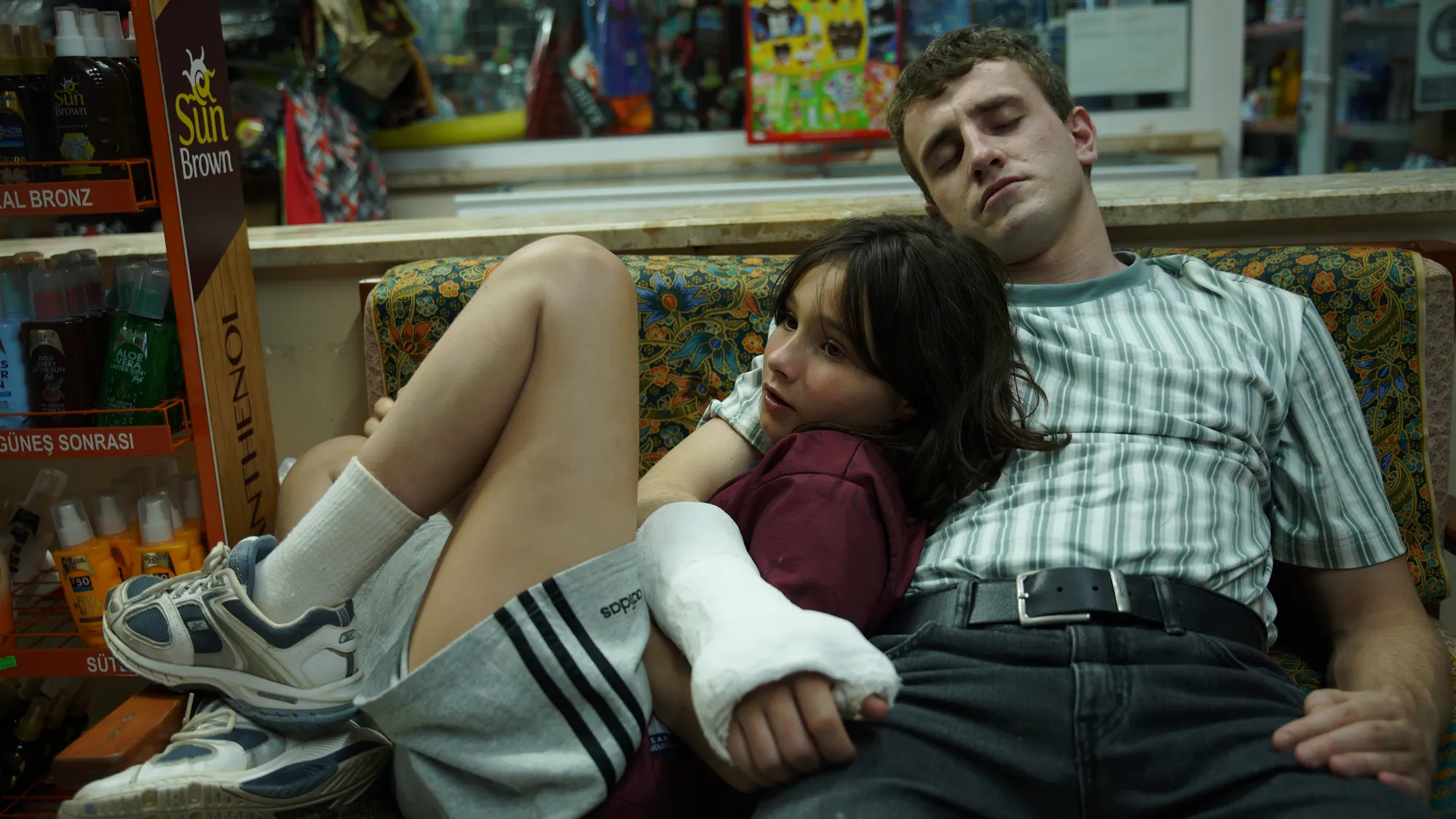
We have been conditioned to accept a lazy version of memory at the movies. You know the formula: a slow zoom into an actor's eyes, an acoustic guitar cue, and a soft-focus dissolve into a sun-drenched 1990s afternoon where everyone speaks in complete, explanatory sentences.
It's memory cleaned up for suburban consumption: tidy, functional, and utterly dead on arrival.
When Charlotte Wells' Aftersun (2022) premiered at Cannes, it offered something altogether different. Rather than using memory to explain the present, Wells made memory the organising principle of the film itself. Moments don't unfold because they advance the plot; they surface because they are the moments an adult Sophie cannot stop returning to.
"Memory became the structure of the film," Wells later said. "It has this retroactive gaze."
That phrase—retroactive gaze—feels like the key to understanding Aftersun (2022). The film asks us to experience memory as it is actually remembered: incomplete, sensory, and frustratingly resistant to explanation. Meaning doesn't arrive through revelation. It accumulates.
Take the karaoke scene. Nothing is explained. No emotional breakthrough arrives. Calum hesitates. Sophie watches. The moment passes. It is only later, after the film has quietly assembled dozens of similarly ordinary moments, that the scene begins to reveal itself. Wells trusts the audience to revisit it in the same way Sophie does: years later, armed with understanding she didn't yet possess.
That confidence distinguishes Aftersun (2022) from so many films about the past. Memory is not treated as evidence to be presented to the audience, but as something partial and unstable. The MiniDV footage, the resort carpets, the fluorescent corridors, and the lingering shots of empty space all become pieces of a memory that can never quite be reconstructed in full.
Whether or not later filmmakers were consciously responding to Aftersun (2022), its formal approach has become increasingly familiar.
Alexandra Romvari's Blue Heron (2023) similarly builds identity from fragments of family archives, allowing remembered images rather than chronology to determine emotional rhythm. Akinola Davies Jr.'s My Father's Shadow (2024) arrives at a comparable place through different means, trusting observation, silence, and accumulated detail over dramatic explanation. These films do not feel derivative. They feel comfortable asking audiences to do more of the work.
That confidence is becoming increasingly visible. Sandra Wollner's Everytime (2026), which arrives at this year's New York Film Festival after premiering in competition at Cannes, has already prompted critics to draw comparisons with Aftersun (2022). Writing after its Cannes premiere, Rory O'Connor noted that the film naturally brings Charlotte Wells' work to mind, finding similar emotional power in what is left unsaid rather than what is explained.
Perhaps that is Aftersun's (2022) real legacy. Not that it invented a new way of making films, but that it reminded filmmakers how much could be achieved by trusting an audience. Three years later, the most interesting echoes of Aftersun (2022) are not found in copied images or borrowed stories. They are found in a growing willingness to let memory behave like memory: fragmented, uncertain, and only fully understood in retrospect.
Everytime will premiere at NYFF this September, US wide release date is unknown at time of writing.
Thank you for reading.