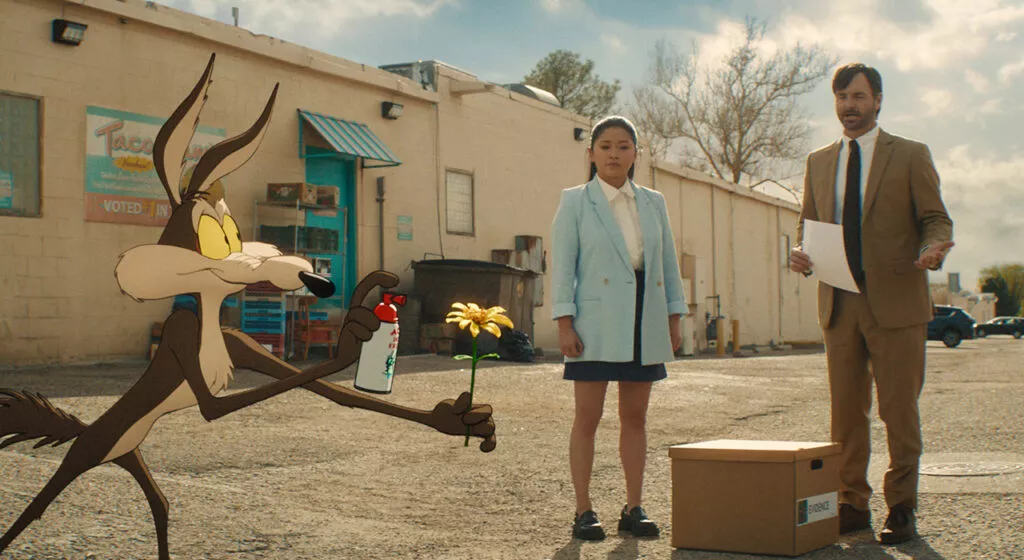
There is something almost too perfect about Coyote vs. Acme finally reaching theaters. A film about a beloved cartoon character taking on the corporation that has spent decades supplying the instruments of his destruction was itself nearly destroyed by the corporation that made it. The irony hardly needs underlining.
And for a while, Coyote vs. Acme seems to know exactly what to do with it.
Wile E. Coyote, having spent the better part of a century purchasing rockets, catapults and assorted explosives that invariably maim him rather than his intended target, decides to sue their manufacturer. His attorney is Kevin Avery (Will Forte), a defeated personal-injury lawyer accustomed to extracting tiny settlements from Acme rather than actually fighting them. Across the courtroom is Buddy Crane (John Cena), Kevin’s former law-school rival and now the swaggering representative of the largest corporation imaginable.
It is a terrific premise. It also presents the movie with an obvious choice: make a Looney Tunes movie structured like a legal thriller, or make a legal satire governed by Looney Tunes physics. Coyote vs. Acme never quite commits to either.
The lawsuit should be the engine of the film. Instead, the courtroom scenes mostly function as staging grounds for the next joke. Evidence rarely changes our understanding of the case. Revelations arrive without substantially raising the danger. Acme is supposedly powerful enough to bend the legal system around itself, but we rarely feel that power bearing down on anyone.
For a movie about an individual challenging an enormous corporation, everything feels strangely low stakes.
Some of this may be unavoidable. Wile E. Coyote has been flattened by boulders, launched off cliffs and blown apart countless times. Physical danger is not exactly persuasive when your protagonist can accordion himself into the desert floor and pop back into shape. But that should make the legal jeopardy more important, not less. If a falling anvil cannot scare us, losing the case has to. The movie never makes it clear enough what defeat would actually mean.
Its morality is similarly muddled. Acme is an obvious corporate villain, but the film is less certain about what Wile E. represents in opposition. Is he an exploited consumer? An obsessive whose own appetite has made him complicit in his suffering? A worker rebelling against a system built to keep him chasing something he can never possess? The movie gestures toward all three and does little with the contradictions between them.
That contradiction is, potentially, the most interesting thing here.
Wile E. is simultaneously victim and architect of his misery. Acme sells him garbage, but he keeps buying it. The Road Runner humiliates him, but nobody has asked him to continue the chase. His rebellion feels inevitable because his submission has lasted so long. Yet overthrowing Acme cannot solve the more fundamental problem: Wile E. is Wile E. because tomorrow morning he will wake up and start chasing the Road Runner again.
That is a far more compelling idea than the movie’s generic corporate morality. There is something oddly moving about a creature defined not by success but by his refusal to accept failure. His mantra is effectively the cartoon version of Sisyphus: the boulder falls, the plan explodes, the bird escapes — draw another blueprint. The film occasionally recognizes the nobility and absurdity of that cycle, but then backs away from examining it too closely. The Coyote is more complicated than the lesson the screenplay wants him to teach.
What saves stretches of Coyote vs. Acme is that it is frequently very funny.
The jokes are best when they feel slightly deranged, as Looney Tunes jokes should. A ludicrous gag about clitoral stimulation lands precisely because it feels like somebody briefly forgot what kind of movie they were making. So does the wonderfully specific declaration that “the Punk scene is very divisive.” They have the anarchic quality missing elsewhere: jokes that exist because someone thought they were funny rather than because they efficiently move a family movie from A to B.
John Cena understands this mode particularly well. Buddy is less a human being than a necktie wrapped around corporate self-belief, and Cena plays him with the correct total absence of embarrassment. Forte, meanwhile, is well suited to sharing the screen with a cartoon. His defeated physicality makes Kevin seem only marginally less animated than his client.
There are enough moments like these to glimpse a much stranger movie underneath the one we get.
Perhaps that is why Coyote vs. Acme disappoints more than a merely bad Looney Tunes adaptation would. The pieces are unusually good. The premise is inspired. Wile E. remains one of animation’s great comic creations. The film even arrived in theaters with a real-world corporate battle that seems almost impossibly tailored to its themes. Yet after everything required to get Coyote vs. Acme released, the movie itself has surprisingly little appetite for a fight.
Wile E. Coyote spends his life chasing something always disappearing over the horizon. For 101 minutes, Coyote vs. Acme does much the same.
Thank you for reading.