Cold has become one of our favourite words for calculated control. It describes someone operating with complete precision: effortless, deliberate and entirely detached. I cannot think of a better word for Andrey Zvyagintsev's latest feature.
His Grand Prix-winning Minotaur operates like a surgeon's scalpel: precise and never rushed. Loosely adapted from Claude Chabrol’s 1969 French thriller The Unfaithful Wife, the film takes Chabrol’s classic bourgeois murder-mystery premise and strips away its sly, mid-century irony. Where Chabrol was fascinated by the polished hypocrisies of French high society, Zvyagintsev transforms the source material into a bleak, unflinching dissection of modern authority and complicity. He reveals only what the audience needs to see, cutting away everything else. Every frame moves forward with quiet, unwavering purpose.
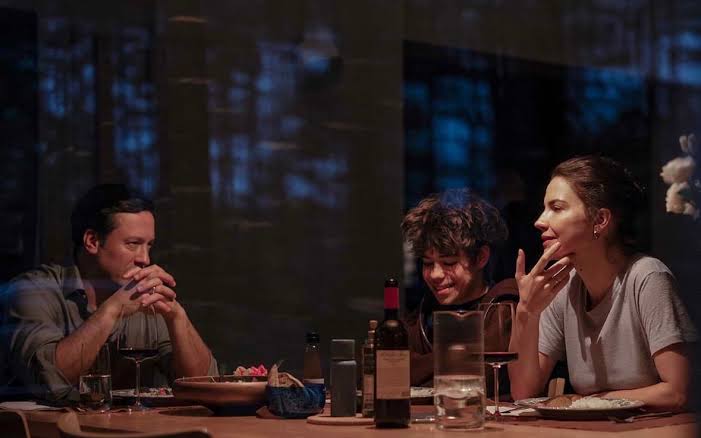
The film follows the slow collapse of a marriage between business executive Gleb (Dmitriy Mazurov) and his wife Galina (Iris Lebedeva). Mazurov gives Gleb a quiet, heavy-shouldered exhaustion—a CEO squeezed between corporate layoffs, government pressures, and his own crumbling home life. Meanwhile, Lebedeva brings a magnetic intensity as a wife whose frustration rarely erupts but is constantly felt. She communicates whole conversations through a shift in posture or by holding someone's gaze a second too long. In one scene, she sits alone in a dark room, her face illuminated only by the blue glow of a phone screen. The shot lasts just a few seconds, yet captures the unbridgeable distance that has opened between them.
While domestic turmoil drives the narrative, Zvyagintsev expands the story's scope far beyond the bedroom. Like his earlier masterworks, Leviathan (2014) and Loveless (2017), Minotaur uses one family's collapse to illuminate a country coming apart. As Russia's invasion of Ukraine unfolds in the background, Gleb's private compromises begin to echo the world beyond his front door. The war is never treated as spectacle. Instead, it quietly reshapes the characters' choices, becoming an unseen pressure that permeates almost every scene.
What stayed with me most was Zvyagintsev's patience. He knows exactly when to move the camera and, more importantly, when not to. Shots linger just long enough to become uncomfortable, particularly during a remarkable sequence between Galina and her lover, allowing silence to achieve what dialogue often cannot. Nothing feels ornamental. Nothing asks to be admired.
Minotaur offers no easy comfort and asks for no easy sympathy. It simply unfolds with unwavering confidence. The final sequence lingers long after the credits roll, bringing the film's emotional and political threads together with devastating restraint.
Distributed by MUBI, Minotaur screens at the New York Film Festival (Sept. 25 – Oct. 12) before its U.S. theatrical release on Nov. 20, 2026.
Thank you for reading.