Image courtesy of NEON.
Once Upon a Time in Harlem begins with an invitation. As Duke Ellington’s “Black Beauty” plays, text welcomes us to a 1972 cocktail party at Ellington’s Harlem home, where William Greaves has assembled artists and intellectuals who helped shape what we now call the Harlem Renaissance. Soon they begin filing through the door: writers, painters, musicians, photographers and activists, dressed for the occasion and greeting people they have not seen in years. There is something almost disorienting about watching them arrive. Names that have hardened into cultural history are suddenly people again—taking off coats, finding seats, catching up with old friends. Richard Bruce Nugent eventually offers perhaps the film’s simplest expression of this divide between history and experience: “While you’re living it, it is the now.” Once Upon a Time in Harlem spends the next hundred minutes exploring the strange distance between those two things: living through a cultural moment and having someone, later, decide what it meant.
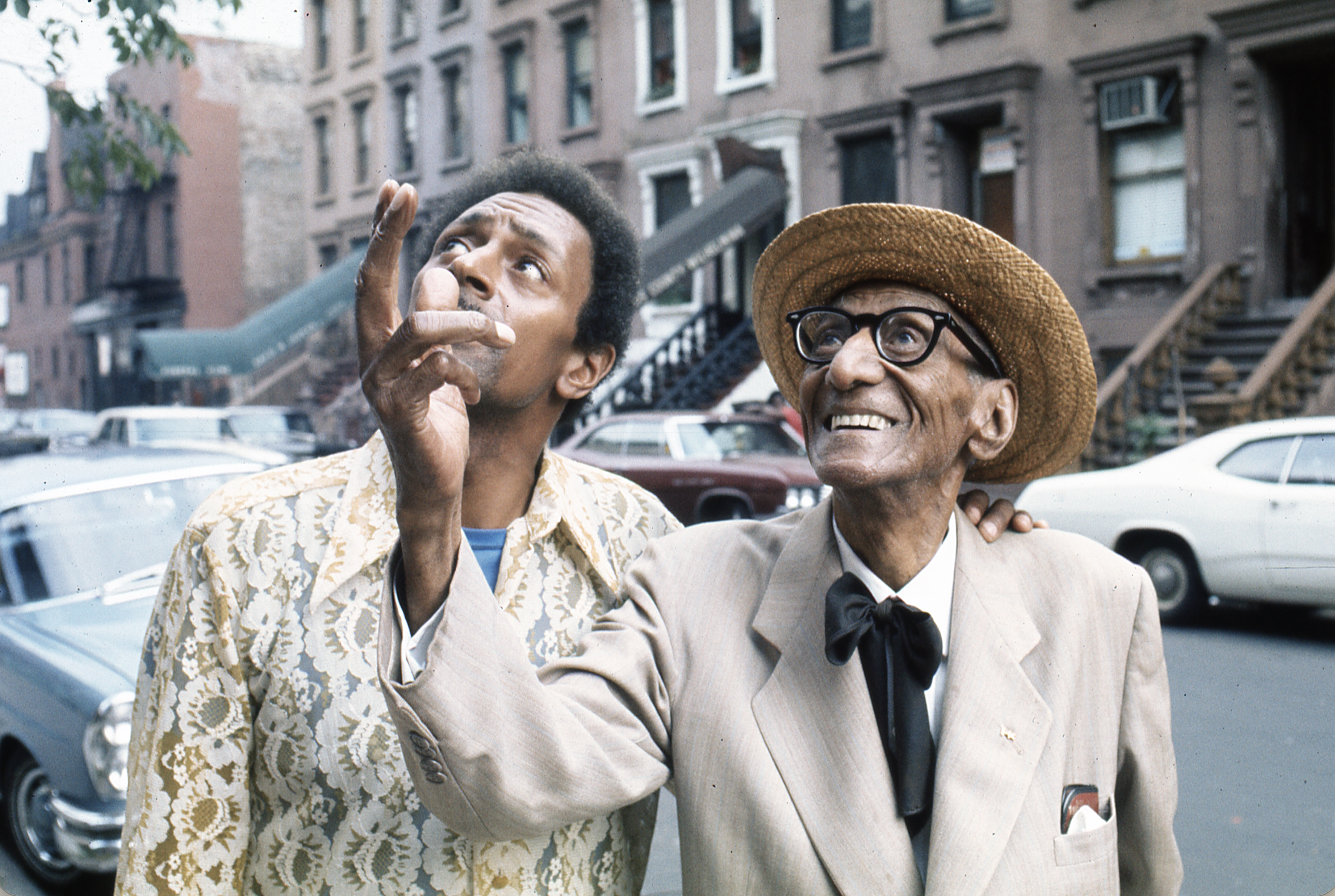
Greaves’s first achievement was recognizing that the distinction mattered at all. By 1972, many of the Harlem Renaissance’s best-known figures were already gone, but Greaves gathered an extraordinary group of those who remained: Arna Bontemps, Aaron Douglas, Richard Bruce Nugent, Eubie Blake, James Van Der Zee, Romare Bearden and others. He did not arrange them behind lecterns or ask them to deliver a clean oral history. Instead, several 16mm cameras move around Ellington’s apartment as drinks are poured, conversations splinter and hands shoot into the air with another memory or correction. The effect is closer to being admitted into the room than being taught a lesson about it. Ida Mae Cullen repeatedly makes sure her late husband, the poet Countee Cullen, receives his due; other guests call out the names of absent figures they fear might otherwise slip from the record. Greaves understood that there was something worth preserving here, but crucially, he did not require the people in front of his camera to agree on what that something was.
That disagreement is what makes the film more interesting than a celebration of a settled historical category. Today, “the Harlem Renaissance” arrives prepackaged: a place, a period, a collection of canonical names. Inside Ellington’s apartment, those boundaries become much less stable. The guests debate the political and economic conditions that made the movement possible, invoke figures who have been pushed toward its margins, and offer competing accounts of its beginnings and significance. Richard B. Moore stresses the political and economic ferment that preceded the artistic explosion; Arna Bontemps starts tracing a chronology through Langston Hughes, Marcus Garvey, Shuffle Along, Claude McKay and Jean Toomer. Around them, others interrupt, elaborate and object. Even the film’s visual need to identify its participants—with names and occupations appearing on screen—feels productively at odds with people who cannot be contained so neatly. A label like “Renaissance” is useful precisely because it allows later generations to recognize that something remarkable happened. But labels also impose coherence retrospectively. Greaves preserves the harder truth: the people who make a movement rarely experience themselves as entries in the chapter that will eventually be written about them.
The film’s form keeps returning to that gap between the historical figure and the person. One of its loveliest moments comes when photographer James Van Der Zee notices Ellington’s piano. He sits down and begins to play, and the movie drifts into his photographs: black-and-white images from an earlier Harlem appearing against the rich color of the 1972 gathering. Elsewhere, split screens place the older faces sitting before Greaves’s cameras beside photographs of their younger selves. The effect is more than illustrative. We are used to encountering the Harlem Renaissance through precisely these archival objects—portraits, newspapers, paintings, poems—where its participants can seem fixed permanently in the past. Greaves reverses the relationship. The still photograph is suddenly attached again to a voice, a sense of humor, a grievance, a face reacting to someone across the room. Meanwhile, the gorgeous color footage that once represented Greaves’s present has itself become an archive. The movie is constantly moving across those layers of time, reminding us that an archive is not history itself. It is the raw material from which somebody later tries to make sense of history.
That process of making sense extends beyond the people on screen to the existence of Once Upon a Time in Harlem itself. William Greaves never finished the film in his lifetime. The footage survived, protected and revisited over decades. After William’s death in 2014, his wife and longtime creative partner, Louise Archambault Greaves, continued working to realize the project. Following her death in 2023, their son David, who had operated one of the cameras at the original gathering, completed the film with producer Liani Greaves, his daughter, and co-producer Anne de Mare. Early in the film, an archival recording catches William breaking from a reading to speak directly to his son: “use that reading, David.” Heard now, in a movie David ultimately brought to completion, the aside lands differently. A film concerned with how one generation hands its history to another turns out to have traveled in exactly the same way.
That may be the film’s most moving answer to its own question. Who gets to name a renaissance? Historians will name it; institutions will preserve it; later generations will argue over its borders. But before any of that can happen, somebody has to notice that the thing in front of them is worth saving. William Greaves did that in an apartment in Harlem in 1972, pointing cameras toward people who were still debating what their own past meant. Half a century later, his family did it again by returning to the material he left behind. Once Upon a Time in Harlem is an extraordinary record of a major chapter in American culture, but its lesson about preservation operates at the smallest scale too. Cultural history often begins as family history: a photograph kept in a drawer, a voice saved on tape, a reel of film that someone refuses to throw away. We cannot always know when we are living through history. We can decide, however, that the stories closest to us are worth keeping.
Image courtesy of NEON.
Thank you for reading.