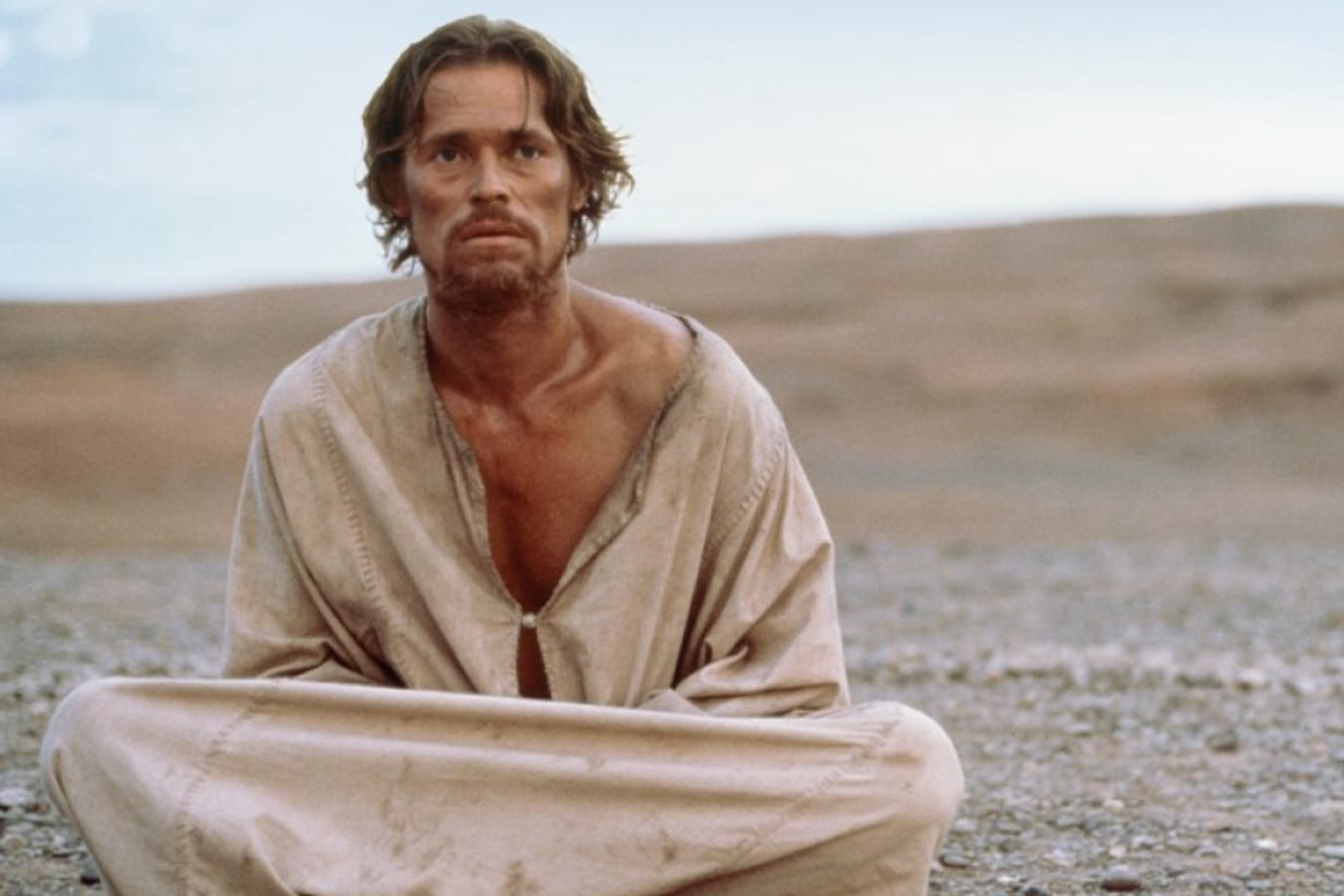
I watched The Last Temptation of Christ (Martin Scorsese, 1988) for the first time this week. I expected a film about faith, doubt and the humanity of Jesus. I did not expect to spend so much of it thinking about The Odyssey (Christopher Nolan, 2026).
Some of that is probably timing. The Odyssey has been on my mind, and suddenly Scorsese’s film seemed full of the same ideas: men living under divine law, gods watching from above, and the uneasy relationship between free will and destiny.
Early in The Last Temptation of Christ, there is a lot of talk about the law of Moses. It determines how people live and what they owe to God. Jesus is trying to understand his place within that order while also being called to change it.
It made me think of Zeus.
The theology is obviously very different, but the arrangement is familiar. Nolan’s Odyssey repeatedly invokes “Zeus’s law,” even as Nolan strips away much of the divine intervention of Homer. The gods rarely appear, but their authority remains.
Scorsese makes that authority feel physical. The desert is bleached and exposed, offering Jesus almost nowhere to hide. Michael Ballhaus’s camera crowds him, tilts around him and sometimes leaves him looking very small against the landscape. Peter Gabriel’s percussion seems to come from somewhere beyond the frame. God does not need to appear for His presence to be felt. Divine purpose can feel less like a calling than something bearing down on Jesus.
That feeling is more recognizable than the theology might suggest. We may not believe our lives have literally been written by a god, but most of us know the strange feeling of discovering that a script seems to exist anyway. We collect ideas about what we should want and who we should become. Eventually it can become difficult to tell which parts we chose ourselves.
Nolan does something different with the same feeling. His gods are mostly absent. Athena is the exception, appearing intermittently to Odysseus, often simply watching. Her presence never feels entirely secure. She can be read as a goddess, but also as memory or guilt taking a recognizable form.
That makes one of Nolan’s images particularly hard to shake. During the sack of Troy, the killing of a woman is intercut with the destruction of Athena’s statue, its head severed and sent crashing to the ground. Later, Athena takes on that same human face. Divine observation and Odysseus’s memory of what happened at Troy begin to blur together.
Scorsese makes being watched feel like destiny. Nolan makes it feel closer to guilt.
There is something familiar in both. Sometimes the person watching us most closely is no longer anyone outside us. Expectations can survive the people or institutions that gave them to us. Guilt certainly can. Eventually the authority becomes internal, and we carry it around ourselves.
Jesus spends most of Last Temptation trying to understand what God wants from him, then resisting it, then fearing it. His final temptation is effective precisely because what he is offered is so modest. He can come down from the cross. He can marry, have sex, raise children and grow old. He can have a home.
Scorsese changes with him. The blood and agony of the crucifixion give way to something quieter and more pastoral. After a film in which faith has so often felt feverish, the alternate life is seductive partly because of how ordinary it looks.
The temptation is not power. It is peace.
And it is, in a sense, exactly what Odysseus wants.
Odysseus spends The Odyssey trying to get back to Ithaca, Penelope and the mortal life that belongs to him. He passes through monsters, war and the supernatural to recover the domestic. Jesus is offered that same destination and has to surrender it.
One man’s temptation is another man’s destination.
Of course, Odysseus’s homecoming isn’t particularly peaceful either. Getting there ultimately means deception, violence and the slaughter of the suitors. Jesus reaches his destiny through the sacrifice of himself; Odysseus gets his home back through the deaths of others. Neither story seems particularly interested in letting ordinary happiness come cheaply.
Nolan complicates it further once Odysseus finally reaches the place he has spent so long trying to return to. Ithaca is still home, but it cannot simply restore what was lost. After the suitors are dead and Telemachus takes the throne, Odysseus and Penelope leave together. Twenty years of wanting to go home ends with another departure.
That contradiction has stayed with me since watching The Last Temptation of Christ. We talk about purpose as though everyone is searching for roughly the same thing: achievement, adventure, love, family, some satisfying combination of them all. But the two films put those things in completely different places.
The life Jesus has to give up is the life Odysseus crosses the world to recover.
There is something painfully familiar in that. We spend years imagining certain destinations for ourselves: a home, a relationship, a career, some version of the person we thought we would become. Sometimes we reach them and find that we have changed on the way there.
And that has changed what interests me about The Odyssey. The monsters and battles are part of it. So is Nolan’s enormous sense of scale. But underneath all of that is a man trying to make his way home through a world in which the gods still have rules, even when they remain out of sight.
The Last Temptation of Christ reminded me how unsettling that can be. And perhaps how familiar.
Thank you for reading.